

 Call Jumeirah
Completing a root canal treatment can feel like the end of a long dental journey.
The toothache has improved, the infection has been treated, and the temporary filling is in place. It is therefore understandable when patients ask:
“If my root canal is complete, why do I still need a dental crown?”
Root canal treatment and the final restoration have two different but equally important roles.
Root canal treatment cleans and seals the infected space inside the tooth. A dental crown protects and rebuilds the remaining structure above the gumline.
Without the right final restoration, a successfully root canal-treated tooth may remain vulnerable to cracking, breaking, leakage, or reinfection.
However, not every root canal-treated tooth automatically needs a crown. The decision depends on the location of the tooth, how much natural structure remains, the size of previous fillings, your bite, and the forces placed on the tooth.
In this guide, we explain why crowns are often recommended after root canal treatment, what can happen if treatment is delayed, and what to expect when receiving dental crowns in Dubai.
What Happens to a Tooth During Root Canal Treatment?
Inside every natural tooth is a soft area called the dental pulp. It contains nerves, blood vessels, and connective tissue.
When the pulp becomes severely inflamed or infected due to deep decay, a crack, trauma, or repeated dental treatment, root canal treatment may be required.
During the procedure, the dentist or endodontist:
- Creates an opening in the tooth
- Removes the inflamed or infected pulp
- Cleans and disinfects the root canals
- Fills and seals the canals
- Closes the access opening with a temporary or permanent restoration
The treatment is designed to control infection and preserve the natural tooth rather than removing it. Once restored properly, the tooth can continue to function during biting and chewing.
What Is a Dental Crown?
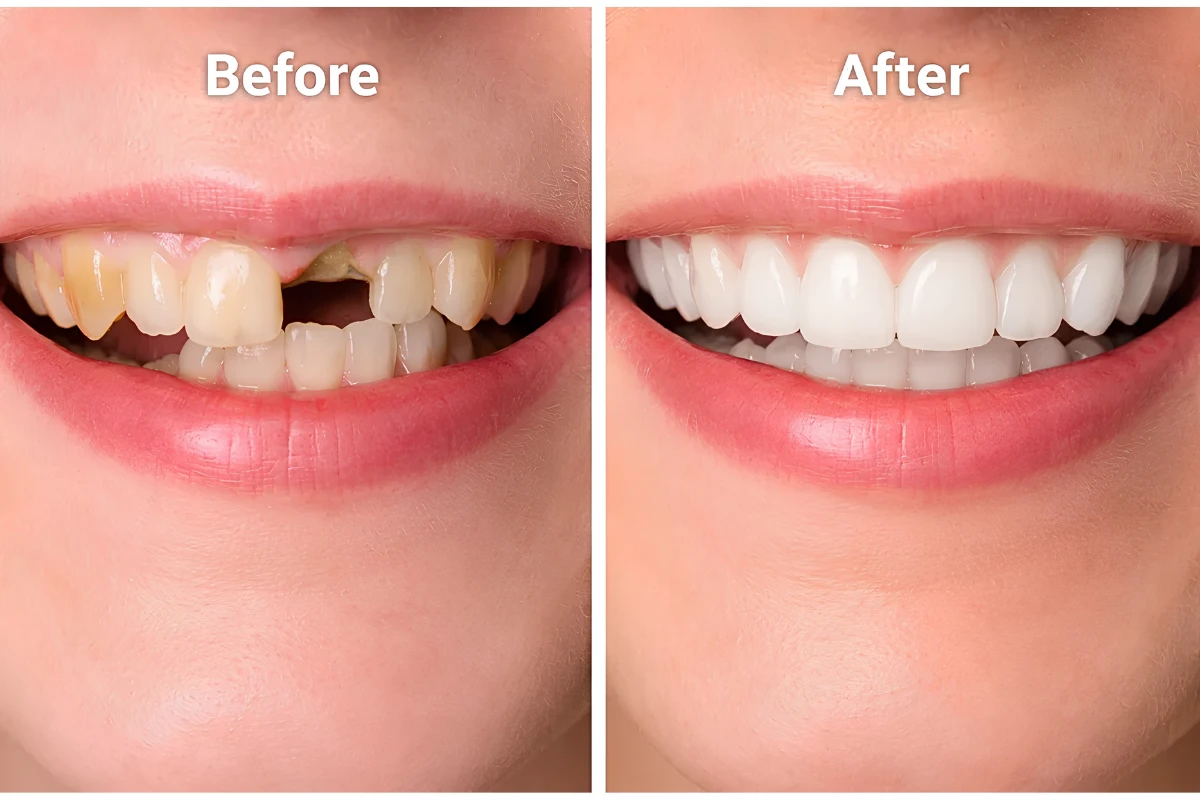
A dental crown, sometimes called a cap, is a custom-made restoration that covers the visible part of a tooth.
It can help restore the tooth’s:
- Strength
- Shape
- Size
- Function
- Appearance
- Contact with neighbouring teeth
- Ability to withstand biting forces
To place a crown, the dentist carefully reshapes the tooth so that the restoration can fit over it securely. The crown is then designed to blend with your bite and, where relevant, the colour of the surrounding teeth.
Dental crowns are commonly used to rebuild teeth that have been badly broken down, weakened by a large cavity, or affected by extensive previous fillings.
Why Is a Crown Often Recommended After Root Canal Treatment?
A tooth normally requires root canal treatment because it has already experienced significant disease or damage.
It may have:
- A deep cavity
- A large existing filling
- A crack
- A fractured cusp
- Repeated previous dental work
- Structural loss caused by trauma
- An access opening created for root canal treatment
All these factors can reduce the amount of healthy tooth structure remaining.
It is sometimes said that a root canal-treated tooth becomes brittle simply because its nerve has been removed. This explanation is incomplete.
Research reviewed by the American Association of Endodontists indicates that the greater risk of fracture is primarily related to the loss of tooth structure from decay, previous restorations, fractures, and the access opening rather than significant drying of the tooth.
A crown helps surround and protect the remaining tooth structure so that chewing forces are distributed more safely.
Five Important Reasons for Placing a Crown After a Root Canal
1. It Helps Protect the Tooth From Fracture
A heavily restored tooth may not be strong enough to tolerate normal chewing pressure without additional protection.
Back teeth have raised areas called cusps. These cusps can flex under pressure, especially when a large filling or access opening has removed the structure that once supported them.
A crown covers the tooth and helps hold the remaining sections together. This can reduce the chance of a cusp or larger part of the tooth breaking during chewing.
A serious fracture can extend below the gum or into the root. In some cases, the damage may become too extensive to repair, and the tooth may need to be removed.
2. It Restores Normal Chewing Function
Root canal treatment manages the infection inside the tooth, but it does not always rebuild the missing biting surface.
A properly designed crown recreates the tooth’s shape so that it can make appropriate contact with the opposing tooth while chewing.
The dentist also checks that the crown is not too high. A high bite can place excessive pressure on the treated tooth and may cause discomfort, particularly when biting.
3. It Creates a Stronger Seal
After root canal treatment, the internal canal system is sealed. The opening made through the top of the tooth must also be protected from bacteria in the mouth.
A permanent restoration helps create a durable outer seal. If a temporary filling breaks, wears down, or leaks, bacteria may be able to enter the tooth again.
Breakdown of a crown or the seal beneath it is one possible reason why a previously root canal-treated tooth may develop a new infection.
4. It Rebuilds a Heavily Damaged Tooth
Many teeth requiring root canal treatment have already lost a large amount of structure before the procedure begins.
A crown can rebuild a tooth that would otherwise be too weak, short, uneven, or damaged to function normally.
In selected cases, the dentist may first create a core build-up using restorative material. This core provides the shape needed to support the crown.
5. It Can Improve the Tooth’s Appearance
A root canal-treated tooth may already be discoloured because of trauma, previous restorations, internal changes, or decay.
A tooth-coloured crown can improve the tooth’s:
- Shade
- Shape
- Surface
- Proportion
- Alignment with neighbouring teeth
This may be especially relevant when a visible front tooth requires extensive restoration.
Does Every Root Canal-Treated Tooth Need a Crown?
No.
Whether a crown is necessary depends largely on the tooth’s location and how much healthy structure remains.
The American Association of Endodontists explains that back teeth, including molars and premolars, generally require crowns because they carry greater chewing forces. Front teeth, such as incisors and canines, may not always need crowns if enough sound tooth structure remains.
Your dentist will assess several factors before recommending the final restoration.
These include:
- Whether the tooth is at the front or back of the mouth
- How much natural enamel and dentine remain
- The size of the access opening
- The size of previous fillings
- Whether the tooth is cracked
- Whether any cusps are unsupported
- How strongly you bite
- Whether you grind or clench your teeth
- Whether the tooth has changed colour
- The health of the surrounding gums and bone
- Whether the tooth can be restored predictably
The aim should be to choose the most conservative restoration that provides adequate protection.
Why Do Back Teeth Usually Need Crowns?
Molars and premolars perform much of the heavy work involved in chewing.
They experience repeated vertical and sideways forces whenever you eat. They also commonly have larger biting surfaces, several cusps, and previous fillings.
If substantial tooth structure has been lost, the remaining cusps may be more likely to crack under pressure.
For this reason, full or partial cuspal coverage is commonly recommended after root canal treatment on back teeth.
Depending on the condition of the tooth, the dentist may recommend:
- A full dental crown
- An onlay
- An overlay
- Another type of cuspal coverage restoration
The final choice depends on the amount and location of the remaining healthy structure.
Do Front Teeth Need Crowns After Root Canal Treatment?
A front tooth may not require a crown when:
- The access opening is small
- Most of the natural tooth remains
- There is no major crack
- There is no large existing filling
- The tooth is not heavily worn
- The appearance can be managed conservatively
In such cases, a bonded tooth-coloured filling may provide sufficient restoration.
A crown may still be recommended when a front tooth is:
- Severely discoloured
- Extensively filled
- Chipped or fractured
- Structurally weak
- Affected by trauma
- Unable to support a conservative filling
- Exposed to heavy bite forces
The dentist should examine the tooth and explain why a crown is or is not necessary rather than applying the same treatment plan to every patient.
How Soon Should a Crown Be Placed After Root Canal Treatment?
The final restoration should generally be arranged promptly after the dentist or endodontist confirms that the root canal treatment is complete.
The exact timing depends on the individual case.
In some situations, the crown can be planned soon after root canal treatment. In others, the dentist may monitor symptoms or healing before completing the final restoration.
What is important is that a temporary filling should not be treated as a permanent solution.
The American Association of Endodontists advises patients to arrange the final crown as soon as the endodontic treatment is complete. Leeds Teaching Hospitals similarly notes that delaying the final restoration can significantly increase the risk of fracture or treatment failure.
Follow the timeline recommended for your tooth rather than delaying because the pain has improved.
What Can Happen If You Delay the Crown?
A tooth can feel comfortable after root canal treatment and remain structurally vulnerable.
Delaying the final restoration may increase the risk of:
Tooth Fracture
The tooth may crack or a cusp may break while chewing.
A small break may be repairable. A deep fracture extending into the root can make the tooth impossible to save.
Temporary Filling Breakdown
Temporary restorations are designed to protect the tooth for a limited period.
They can wear down, loosen, fracture, or fall out. This may expose the internal treatment to saliva and bacteria.
Reinfection
If the seal over the tooth breaks down, bacteria may enter the root canal system again.
This can lead to renewed pain, swelling, infection, or the need for root canal retreatment.
Additional Treatment
A tooth that could originally have been restored with a straightforward crown may later need:
- A larger core build-up
- A post
- Crown lengthening
- Root canal retreatment
- Endodontic surgery
- Extraction
Delaying the restoration can therefore affect both the treatment complexity and the long-term prognosis.
Can You Chew Normally Before the Crown Is Placed?
You should be cautious with the treated tooth until your dentist confirms that the final restoration is complete.
Avoid:
- Chewing ice
- Biting hard sweets
- Cracking nuts
- Biting directly into very hard food
- Using the treated tooth to open packaging
- Chewing heavily on the temporary restoration
The American Association of Endodontists recommends avoiding hard foods and heavy biting on the treated tooth until it has been fully restored.
You can usually continue brushing and cleaning between the teeth, but be gentle around the treated area and follow your dentist’s instructions.
What Is a Core Build-Up?
When a large part of a tooth is missing, the dentist may need to rebuild it before placing the crown.
This foundation is called a core build-up.
The core replaces missing tooth structure and creates the shape over which the crown can fit. It may be made using a strong tooth-coloured restorative material.
A core build-up and a crown have different functions:
- The core rebuilds the missing central structure.
- The crown covers and protects the tooth from the outside.
Not every root canal-treated tooth needs a separate core build-up. It depends on how much structure remains.
Will You Need a Post After Root Canal Treatment?
Not every tooth needs a post.
A post is a metal or fibre component placed inside part of a prepared root canal when there is not enough remaining tooth structure to retain the core.
The main purpose of a post is to help hold the core in place. It is not automatically placed simply because a tooth has undergone root canal treatment.
A post may be considered when:
- The tooth is severely broken down
- Very little structure remains above the gum
- A core cannot be retained adequately without additional support
- The planned crown requires a more stable foundation
Placing a post requires careful planning because unnecessary removal of root structure can increase the risk of complications.
Your dentist will determine whether a post is truly needed.
What Types of Crowns Can Be Used?
Different crown materials are available, and no single option is ideal for every tooth.
The choice may depend on:
- The tooth’s location
- The amount of biting pressure
- Available tooth structure
- Aesthetic expectations
- The colour of the underlying tooth
- The condition of neighbouring teeth
- Available space
- Teeth grinding habits
- Your dentist’s clinical assessment
Common options include:
All-Ceramic Crowns
Ceramic crowns are often selected when a natural-looking appearance is important.
They can be designed to match the shade and translucency of surrounding teeth and may be suitable for front or selected back teeth.
Zirconia Crowns
Zirconia is a strong ceramic material frequently considered for teeth exposed to significant chewing pressure.
Its appearance and design can be customised according to the tooth’s position and the patient’s needs.
Porcelain-Fused-to-Metal Crowns
These crowns have a metal base covered by tooth-coloured porcelain.
They combine structural support with an aesthetic outer surface, although the material choice must be evaluated for each patient.
Metal Crowns
Metal crowns are highly durable and may require less removal of tooth structure in selected circumstances.
Because of their colour, they are usually considered for less visible areas.
Your dentist will explain the benefits and limitations of the materials suitable for your tooth.
What Happens During the Dental Crown Procedure?
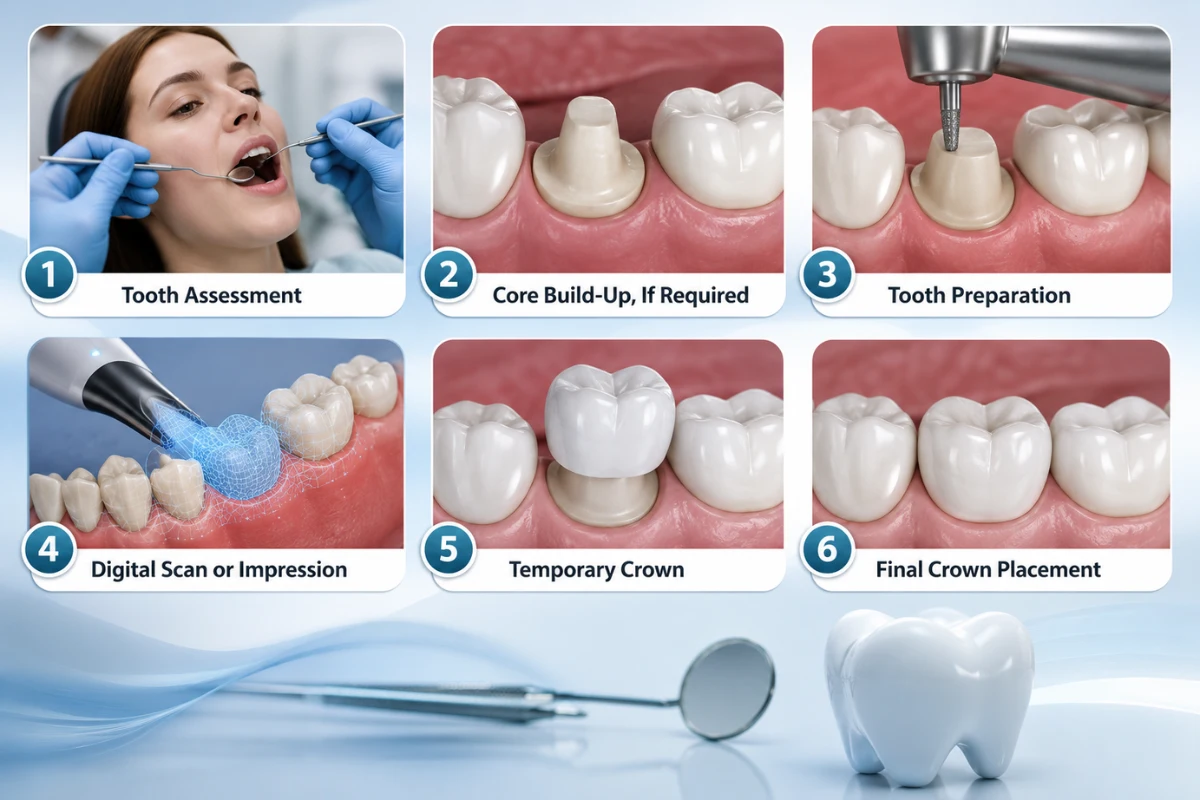
The exact process can vary, but treatment commonly involves the following stages.
1. Tooth Assessment
The dentist examines the tooth, surrounding gums, bite, root canal treatment, and available structure.
Dental X-rays may be taken to assess the roots and surrounding bone.
2. Core Build-Up, If Required
Missing tooth structure is rebuilt to create a stable foundation.
A post may be placed only when necessary.
3. Tooth Preparation
The tooth is carefully reshaped to create enough space for the crown.
The amount of preparation depends on the material selected, the tooth’s condition, and the intended crown design.
4. Digital Scan or Impression
A digital scan or traditional impression records the prepared tooth, neighbouring teeth, and bite.
This information is used to design the custom crown.
5. Temporary Crown
A temporary crown may be placed while the final restoration is being created.
It protects the prepared tooth and helps maintain appearance and spacing.
6. Final Crown Placement
The dentist checks the crown’s:
- Fit
- Shape
- Colour
- Contact with neighbouring teeth
- Bite
- Comfort
Once the dentist and patient are satisfied, the crown is bonded or cemented in place.
How Long Does a Crown Last?
A crown is a long-term restoration, but it is not guaranteed to last forever.
Its lifespan depends on:
- Oral hygiene
- Crown material
- Quality of fit
- Amount of remaining tooth structure
- Bite forces
- Teeth grinding
- Diet
- Gum health
- Regular dental attendance
- Accidental trauma
A well-treated and properly restored root canal tooth can remain functional for many years and may last as long as other natural teeth.
Regular examinations allow the dentist to monitor the crown, its edges, the supporting tooth, and the surrounding gums.
Can a Crowned Root Canal Tooth Still Develop Problems?
Yes.
A crown protects the tooth, but it does not make it immune to future dental problems.
Possible concerns include:
- Decay at the edge of the crown
- Gum inflammation
- Crown loosening
- Crown fracture
- Wear of the opposing tooth
- Bite changes
- Root fracture
- Reinfection inside the tooth
- Pain from surrounding tissues
Contact your dentist if you notice:
- Pain while biting
- New swelling
- A recurring gum pimple
- A loose crown
- An unpleasant taste
- Food becoming trapped around the crown
- A chipped or fractured restoration
- Pain returning in a previously treated tooth
A previously root canal-treated tooth may sometimes be saved through retreatment if a new problem develops.
How Should You Care for a Crowned Tooth?
A crowned tooth still needs daily care because the natural tooth remains underneath it.
To protect your crown:
- Brush twice daily with fluoride toothpaste
- Clean between your teeth every day
- Pay attention to the gumline around the crown
- Avoid chewing ice and extremely hard objects
- Attend regular dental check-ups
- Arrange professional cleanings as recommended
- Wear a sports mouthguard when necessary
- Use a night guard if prescribed for grinding
- Do not ignore a loose or uncomfortable crown
Good oral hygiene helps reduce the risk of decay around the crown margin and inflammation of the nearby gums.
Complete the Treatment, Not Just the Root Canal
Root canal treatment removes infection and helps save the natural tooth. The final restoration protects the work that has already been completed.
For many back teeth, a crown is an important part of the treatment rather than an optional cosmetic addition.
The right crown can help:
- Protect the tooth from fracture
- Restore chewing function
- Rebuild missing structure
- Improve appearance
- Maintain a reliable outer seal
- Support the tooth for long-term use
The need for a crown should always be based on the condition of the individual tooth. Some teeth need full coverage, while others can be restored more conservatively.
Looking for dental crowns in Dubai after root canal treatment? Book a consultation at Dentistree for a complete assessment and a personalised restoration plan designed to protect your natural tooth.
Frequently Asked Questions
Is a crown always compulsory after root canal treatment?
No. Back teeth generally require more protection because they experience heavier chewing forces. Some front teeth with substantial healthy structure may be restored using a bonded filling instead.
The dentist should assess the tooth individually.
Why does my tooth not hurt even though it still needs a crown?
Root canal treatment removes the inflamed or infected pulp, so the original toothache may improve.
However, the remaining tooth structure may still be weak. The crown is recommended for protection and function, not because the tooth is currently painful.
Can I leave the temporary filling if it feels fine?
A temporary filling is not intended to act as the final long-term restoration.
Even when it feels comfortable, it may wear, leak, loosen, or break. Arrange the permanent restoration within the timeframe advised by your dentist.
Is getting a crown painful?
The tooth and surrounding area are usually numbed during crown preparation.
You may feel pressure or vibration, but you should tell the dentist if you experience discomfort. Mild gum or bite sensitivity may occur temporarily after treatment.
Can a root canal be performed through an existing crown?
In some situations, a dentist or endodontist may access the root canals through an existing crown.
Whether the crown can remain depends on its condition, fit, material, and the reason for treatment. It may need to be repaired or replaced afterwards.
Can I choose the colour of my crown?
For tooth-coloured crowns, the shade is selected to blend with surrounding teeth.
The dentist also considers translucency, tooth position, underlying discolouration, and lighting when planning the final appearance.
What happens if my temporary crown falls off?
Contact your dental clinic promptly.
Avoid chewing on the exposed tooth, keep the crown if you can find it, and do not attempt to glue it back using household adhesive.