

 Call Jumeirah
Losing a tooth can affect much more than your appearance.
It may make eating uncomfortable, change the way you speak, affect your confidence, and leave you worried about smiling in social or professional settings. Understandably, many patients do not want to spend months with a visible gap while waiting for a replacement tooth.
This is why same-day dental implants have become an appealing option.
In selected cases, a dental implant can be placed and connected to a temporary tooth within a very short period, sometimes during the same appointment. However, “same-day” does not mean that every stage of treatment, healing, and final restoration is completed in one day.
Same-day implant treatment requires careful planning, suitable bone, healthy surrounding tissues, good implant stability, and controlled biting pressure. It is not automatically the right option for every missing tooth or every patient.
If you are considering same-day dental implants in Dubai, this guide explains what the treatment involves, who may qualify, what happens on the day, and what you should know before making a decision.
What Is a Dental Implant?
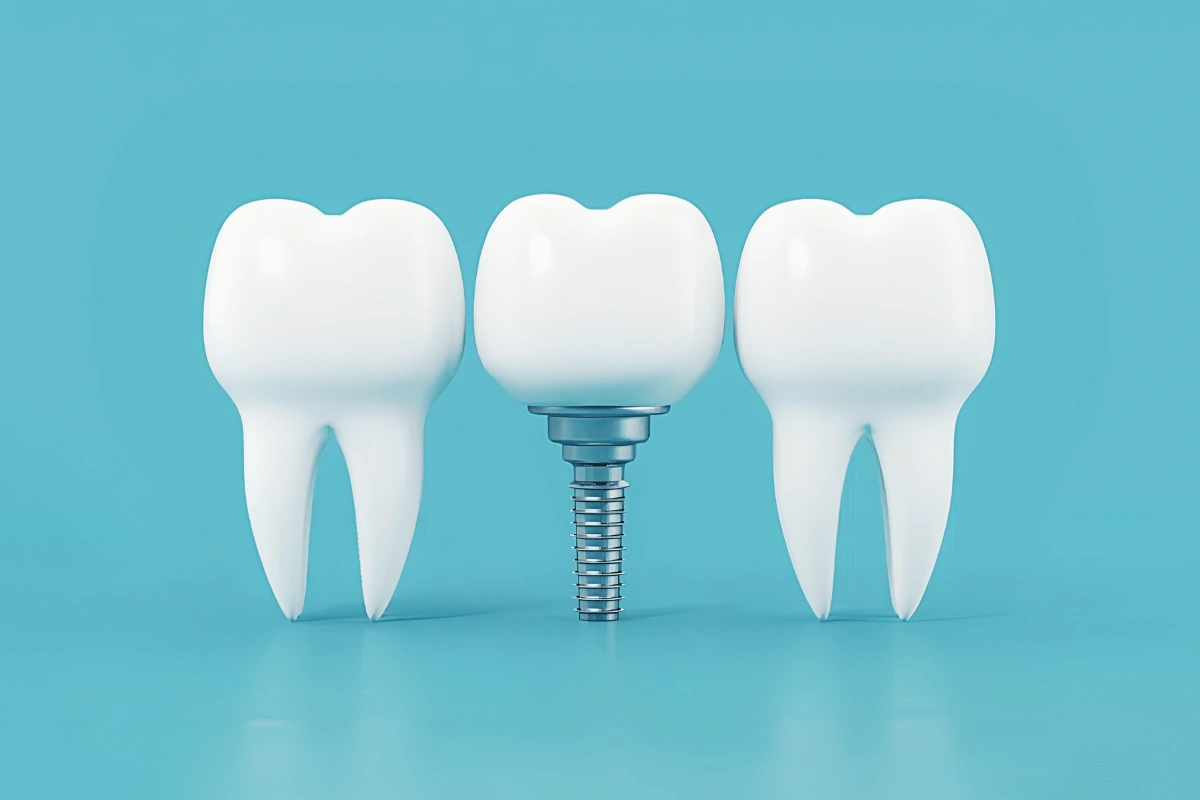
A dental implant is a small component placed into the jawbone to replace the root of a missing tooth.
Once the implant has integrated with the surrounding bone, it can support a dental restoration such as:
- A single crown
- An implant-supported bridge
- A removable implant-supported denture
- A fixed full-arch restoration
For a single missing tooth, the implant supports an individual crown without requiring the neighbouring teeth to be reduced to support a conventional bridge.
Dental implant treatment usually has three main parts:
- The implant: Placed within the jawbone
- The abutment: Connects the implant to the restoration
- The crown or prosthesis: Replaces the visible tooth
The exact treatment sequence depends on the condition of the bone and gums, the number of teeth being replaced, and the stability achieved when the implant is placed.
What Are Same-Day Dental Implants?
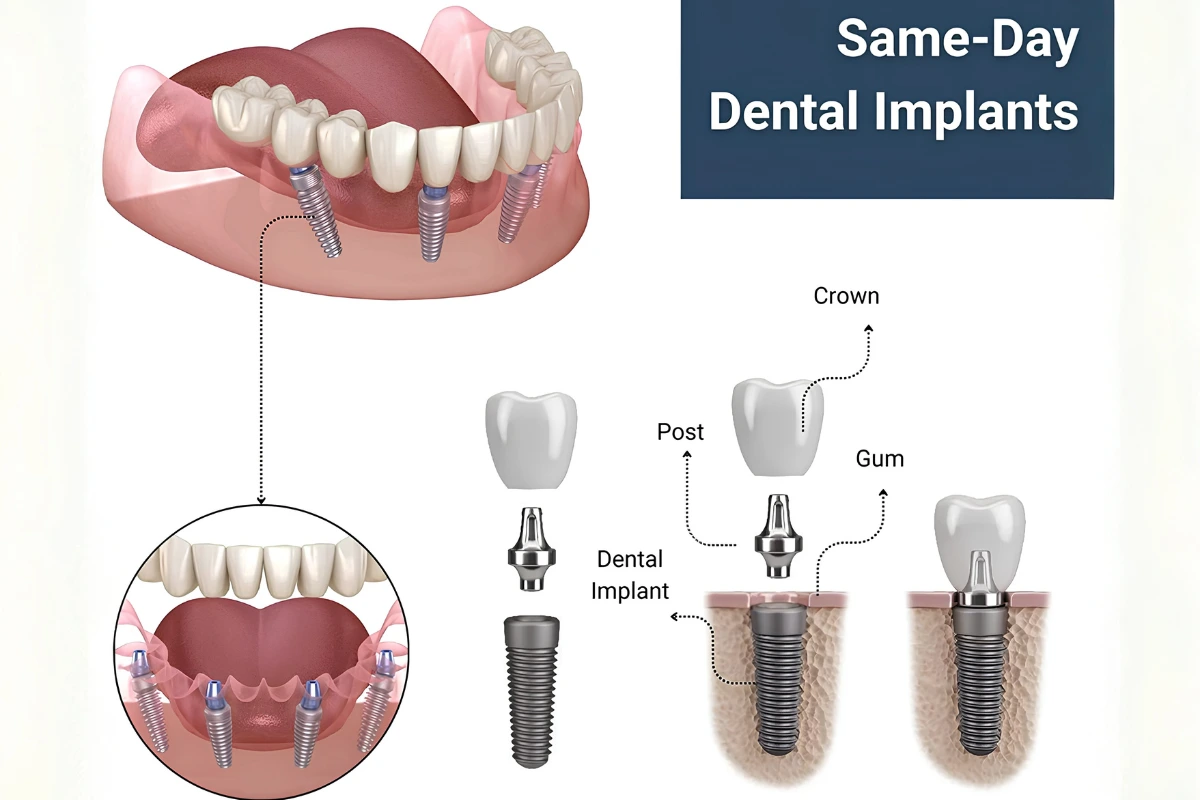
Same-day dental implants are also known as immediate-load dental implants or “teeth in a day”.
In this approach, the dental implant is placed and connected to a temporary tooth or prosthesis during the same appointment or shortly afterwards. According to the International Team for Implantology, immediate loading means connecting an implant to a restoration that contacts the opposing teeth within one week of implant placement.
A same-day restoration may be:
- A temporary crown for one missing tooth
- A temporary bridge for several missing teeth
- A temporary full-arch prosthesis supported by several implants
The temporary restoration allows the patient to avoid a visible gap during the early healing stage. However, it must be carefully designed to avoid placing uncontrolled pressure on the new implant.
Does “Same-Day” Mean You Receive the Final Tooth That Day?
Usually, no.
In many cases, the restoration provided on the day of implant surgery is temporary. It is designed to support appearance and selected function while the implant heals within the bone.
Once healing is satisfactory, the temporary restoration may be replaced with a final custom-made crown, bridge, or full-arch prosthesis.
The final restoration can be designed with:
- More precise bite contacts
- Improved shape
- Better surface texture
- Final tooth colour
- Stronger long-term materials
- Better contact with neighbouring teeth
- A refined fit around the gums
Patients should therefore understand that “same-day teeth” usually refers to receiving a temporary tooth quickly, not completing the entire implant process in one appointment.
Immediate Implant Placement and Immediate Loading Are Not the Same
These terms are often used interchangeably, but they describe different stages of treatment.
Immediate Implant Placement
Immediate placement means that a damaged or failing tooth is removed and the implant is inserted into the extraction socket during the same procedure.
Immediate Loading
Immediate loading means that a restoration is connected to the implant within the first week and is designed to receive controlled contact with the opposing teeth.
Immediate Restoration
An immediate restoration is also connected within the first week, but it may be kept out of direct biting contact while the implant heals.
A patient may therefore receive:
- Immediate placement without an immediate tooth
- Implant placement into already healed bone with an immediate tooth
- Immediate placement and immediate restoration
- Immediate placement followed by delayed loading
The most suitable combination depends on the condition of the tooth, bone, gum, bite, and implant stability.
What Are the Potential Benefits of Same-Day Dental Implants?
When used in a suitable case, same-day implant treatment may offer several advantages.
1. You May Avoid a Visible Gap
This is particularly important when a front tooth needs to be removed.
A temporary tooth can often be designed before surgery and connected after the implant has been placed, allowing the appearance of the smile to be maintained during healing.
2. Fewer Separate Surgical Stages May Be Required
In selected cases, extraction, implant placement, and temporary restoration can be combined into one planned procedure.
This may reduce the number of separate appointments compared with a traditional staged approach.
3. The Gum Shape May Be Better Supported
An immediate temporary crown can help support the gum contours around a front tooth while the area heals.
This requires highly precise planning because the position and shape of the implant restoration can influence the final appearance of the gumline.
4. You Receive an Early Improvement in Appearance
Patients may feel more comfortable speaking, smiling, attending work, and participating in social events when they are not left with a visible gap.
5. Treatment May Feel More Convenient
Combining certain stages can make treatment feel more manageable for patients with demanding schedules.
However, convenience should never take priority over safety, implant stability, or the long-term health of the surrounding bone and gums.
Are Same-Day Dental Implants Suitable for Everyone?
No.
Immediate implant loading is a technique-sensitive treatment that depends on careful patient and site selection.
The implant must usually achieve strong initial stability within the bone. The dentist must also consider bone quality, the need for grafting, implant design, biting forces, health conditions, patient habits, and the clinician’s experience.
You may be considered for same-day treatment when:
- You have sufficient bone volume
- The bone can provide good implant stability
- Your gums are reasonably healthy
- There is no uncontrolled gum disease
- The implant can be placed in a suitable position
- Your bite can be controlled
- You can follow a soft-food diet during healing
- You maintain good oral hygiene
- You attend follow-up appointments
- Your general health is suitable for implant surgery
A clinical examination and three-dimensional assessment may be required before the dentist can confirm whether immediate treatment is appropriate.
When Might Same-Day Implant Treatment Not Be Recommended?
A delayed approach may be safer when there is:
- Insufficient bone
- A large bone defect
- Significant gum recession
- Uncontrolled gum disease
- A need for substantial bone augmentation
- Poor initial implant stability
- Heavy teeth grinding or clenching
- An unfavourable bite
- Poor oral hygiene
- Uncontrolled medical conditions
- Inability to follow post-treatment instructions
- A high risk of placing excessive pressure on the temporary tooth
The presence of infection does not automatically rule out immediate implant placement in every case, but the condition of the socket, surrounding bone, soft tissue, and infection must be assessed carefully.
In some situations, removing the tooth and allowing the area to heal before placing the implant provides a more predictable result.
What Is a Same-Day Single-Tooth Implant?
A same-day single-tooth implant may be considered when one damaged or missing tooth needs to be replaced.
For example, a front tooth may be:
- Fractured below the gumline
- Severely decayed
- Damaged by trauma
- Affected by an unsuccessful root canal
- Structurally impossible to restore
If the bone and gum conditions are suitable, the tooth may be removed, an implant placed, and a temporary crown connected during the same appointment.
Patients researching a single tooth implant in Dubai should understand that the temporary crown may be kept slightly out of the bite. This helps reduce pressure and movement while the implant begins to integrate with the bone.
The patient must also avoid biting directly into hard food with the temporary tooth during the healing period.
What Happens During the Same-Day Implant Process?
Same-day treatment may happen quickly on the surgical day, but considerable planning takes place beforehand.
Step 1: Implant Consultation
The dentist begins by discussing:
- Which tooth or teeth are missing
- Why the tooth needs replacement
- Your medical history
- Current medications
- Previous dental treatment
- Smoking habits
- Teeth grinding
- Your expectations
- Your preferred timeline
The dentist will also examine the teeth, gums, bite, and jaw.
Step 2: Dental Imaging and Digital Planning
Dental X-rays and, when indicated, three-dimensional imaging may be used to assess:
- Bone height and width
- Root position
- Nerves and other anatomical structures
- The shape of the extraction socket
- Infection or bone loss
- Implant size and position
- The need for grafting
Digital scans, photographs, and bite records may also be taken to plan the temporary tooth.
Step 3: Tooth Extraction, If Required
If a damaged tooth is still present, it is carefully removed.
The dentist aims to preserve as much surrounding bone and gum tissue as possible, particularly in the smile zone.
Step 4: Implant Placement
A space is prepared in the jawbone, and the implant is inserted in the planned position.
The dentist then assesses the stability of the implant. Strong primary stability is one of the most important considerations when deciding whether an immediate restoration can be connected.
Step 5: Bone Grafting, If Necessary
There may be a gap between the implant and the wall of the extraction socket.
In selected cases, bone grafting material may be placed around the implant to support healing and maintain the surrounding contours.
The need for grafting does not always prevent a temporary tooth from being fitted, but substantial augmentation may make delayed loading more appropriate.
Step 6: Temporary Tooth Placement
A temporary crown or prosthesis is connected to the implant.
For a single front tooth, it may be shaped to support appearance while avoiding heavy biting contact.
The dentist checks:
- Fit
- Appearance
- Gum pressure
- Bite
- Stability
- Ease of cleaning
Step 7: Healing and Follow-Up
The implant then goes through a biological healing process in which the bone forms a stable connection around its surface.
Follow-up visits allow the dentist to monitor:
- Gum healing
- Implant stability
- Oral hygiene
- The temporary restoration
- Biting pressure
- Signs of infection
- Bone response
Step 8: Final Restoration
Once the implant has healed sufficiently, new records may be taken for the final crown or prosthesis.
The permanent restoration is then designed, fitted, and adjusted.
Is Same-Day Implant Surgery Painful?
Implant surgery is normally performed using local anaesthesia to numb the treatment area.
During the procedure, you may feel pressure or vibration, but you should not be expected to tolerate sharp pain. Sedation may be discussed for particularly anxious patients or more extensive treatment.
After surgery, temporary discomfort may include:
- Mild to moderate soreness
- Gum tenderness
- Swelling
- Minor bruising
- Slight bleeding or oozing
- Tightness around the surgical area
The extent of recovery depends on the number of implants, whether a tooth was extracted, whether grafting was required, and the complexity of surgery.
Your dentist will provide individual instructions and advise you which pain medication is suitable based on your health and medical history.
What Can You Eat After Same-Day Dental Implants?
Even though a temporary tooth is present, the implant is still healing.
A soft-food diet is usually important during the initial healing period. Excessive pressure or repeated movement may interfere with implant stability.
Suitable foods may include:
- Soft rice
- Pasta
- Eggs
- Yoghurt
- Soup that is not too hot
- Mashed vegetables
- Soft fish
- Smoothies eaten with a spoon
- Well-cooked vegetables
- Soft fruit without hard seeds
Avoid:
- Nuts
- Hard bread
- Ice
- Hard sweets
- Popcorn kernels
- Tough meat
- Sticky food
- Biting directly into apples or carrots
- Chewing heavily on the implant site
Follow the diet advised by your implant dentist because the restrictions may vary according to the location and number of implants.
How Should You Care for a Same-Day Implant?
Good oral hygiene supports the health of the tissues around the implant.
After treatment:
- Follow the cleaning instructions provided by the clinic
- Brush the remaining teeth carefully
- Use any prescribed mouth rinse correctly
- Avoid disturbing the surgical site
- Do not pull at the temporary tooth
- Avoid smoking
- Follow the recommended diet
- Attend all review appointments
- Report unusual movement or increasing pain
Do not attempt to tighten, remove, or adjust the temporary restoration yourself.
If the temporary crown feels loose or the bite feels unusually heavy, contact the dental clinic promptly.
What Are the Risks of Same-Day Dental Implants?
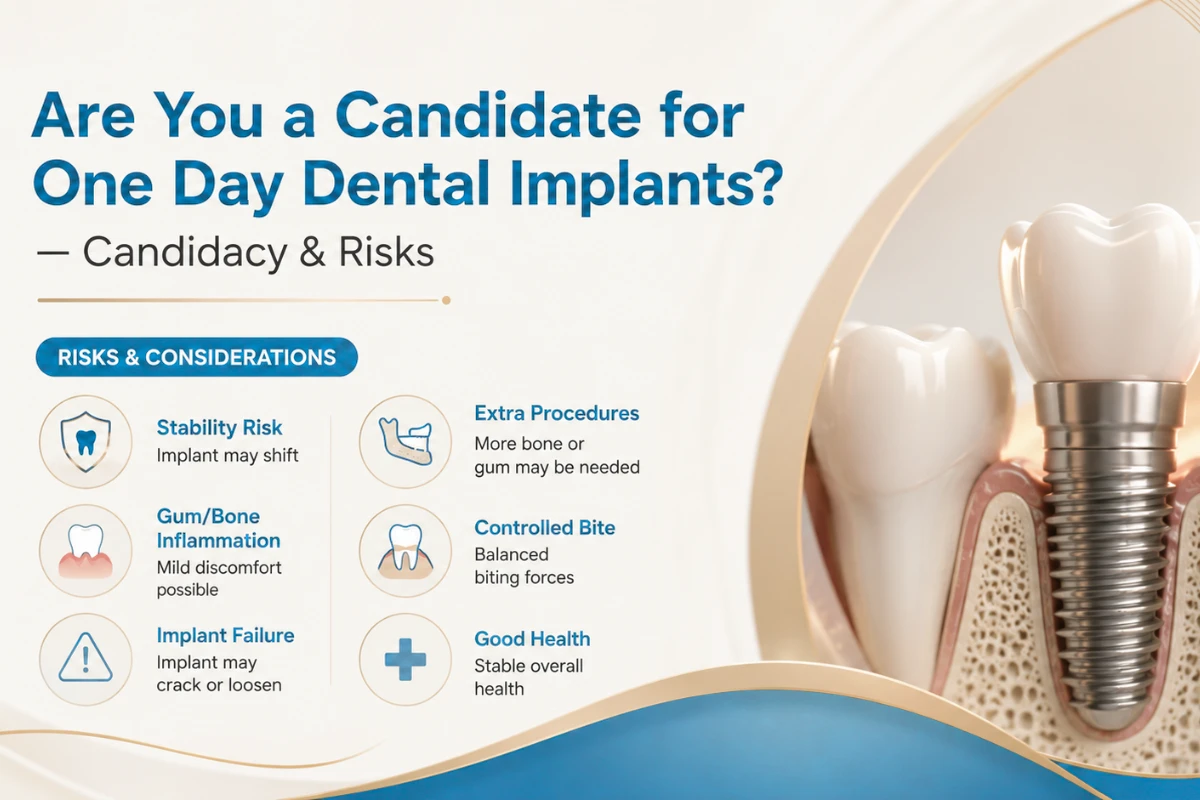
All dental implant procedures carry potential risks, even when they are carefully planned.
Possible complications include:
- Implant movement during healing
- Failure of the implant to integrate
- Infection
- Gum recession
- Bone loss
- Temporary crown fracture
- Loosening of the restoration
- Aesthetic changes around the gumline
- Injury to neighbouring structures
- Bite-related overload
- Need for additional grafting
- Need to remove and replace the implant
Immediate loading can produce successful results in properly selected patients, but the evidence does not mean it should be used routinely for every case. Reviews of single-tooth implants have found favourable results under controlled conditions, while also emphasising case selection and the limitations of available evidence.
For front teeth, aesthetic expectations make planning especially important. Immediate placement should be limited to suitable cases where the gum, bone, implant position, and long-term appearance can be managed predictably.
How Successful Are Same-Day Dental Implants?
Same-day implants can have high survival rates when correct clinical criteria are met.
Recent implant literature supports immediate placement and loading as a clinically documented option in carefully selected cases. However, success depends on much more than simply placing a tooth quickly. Implant stability, bone quality, surgical precision, bite control, restoration design, oral hygiene, and patient cooperation all influence the result.
It is also important to distinguish between:
Implant Survival
The implant remains present in the mouth.
Implant Success
The implant remains stable, healthy, functional, comfortable, and supported by acceptable bone and gum conditions.
A treatment should therefore not be judged only by whether the implant remains in place. Appearance, ease of cleaning, bite comfort, bone health, gum stability, and restoration quality also matter.
Same-Day vs Traditional Dental Implants
| Feature | Same-Day Implants | Traditional Implant Treatment |
| Temporary tooth | Often fitted quickly | May be delayed or replaced with a removable temporary option |
| Implant loading | Immediate or within the first week | After a longer healing period |
| Eligibility | Requires suitable conditions | Suitable for a wider range of cases |
| Initial stability | Must generally be strong | May be allowed to heal without early loading |
| Bone grafting | Limited grafting may sometimes be possible | More extensive grafting can be completed before loading |
| Number of appointments | Certain stages may be combined | Treatment is usually more staged |
| Healing | Still required | Still required |
| Final restoration | Usually fitted later | Fitted after healing |
| Main advantage | Early appearance and convenience | Greater flexibility for complex situations |
Neither option is automatically better.
The best protocol is the one that provides the safest and most predictable long-term result for your specific tooth, bone, gum, bite, and health.
Can Same-Day Implants Be Used for Full-Mouth Treatment?
Yes, selected patients may receive a temporary full-arch restoration supported by several implants on the day of surgery.
This approach may be considered when:
- Most or all teeth in one arch cannot be saved
- Several implants can achieve strong initial stability
- The implants can be connected through a fixed temporary bridge
- Bone distribution is suitable
- The patient can follow strict aftercare instructions
Full-arch same-day treatment is different from replacing a single tooth.
The implants are strategically positioned and connected to a temporary prosthesis. The restoration may replace both teeth and some lost gum tissue.
The final prosthesis is generally produced after healing and may use different materials from the immediate temporary bridge.
What If You Do Not Have Enough Bone?
Insufficient bone does not always mean that you cannot receive a dental implant.
Depending on the location and extent of bone loss, treatment may include:
- Socket preservation
- Bone grafting
- Ridge augmentation
- Sinus augmentation
- A staged implant procedure
- Alternative implant positions
- A bridge or another tooth replacement option
However, significant grafting may mean that a same-day temporary tooth supported by the implant is not advisable.
Your dentist may recommend allowing the graft or implant to heal before applying pressure.
How Much Do Same-Day Dental Implants Cost in Dubai?
The cost varies because same-day implant treatment is not one standard procedure.
Factors that may affect the total fee include:
- Number of implants
- Single-tooth or full-arch treatment
- Tooth extraction
- Bone grafting
- Type of imaging
- Need for digital planning
- Temporary restoration
- Final crown or prosthesis
- Implant and restorative materials
- Anaesthesia or sedation
- Complexity of the case
- Follow-up care
When comparing the cost of dental implants in Dubai, ask whether the quotation includes:
- Implant placement
- Implant component
- Abutment
- Temporary tooth
- Final crown
- Extraction
- Bone grafting
- Imaging
- Review appointments
A low initial price may not include every stage of treatment.
The safest decision should be based on diagnosis, treatment quality, clinician experience, implant position, restorative planning, and follow-up care rather than cost alone.
Dental Implant, Bridge, or Removable Tooth: Which Is Better?
Dental implants are not the only way to replace a missing tooth.
Alternatives may include:
Dental Bridge
A bridge uses neighbouring teeth to support a replacement tooth.
It may be completed more quickly in selected situations, but the supporting teeth usually need to be prepared.
Removable Partial Denture
A removable appliance can replace one or several missing teeth.
It may be more affordable initially but must be removed for cleaning and may feel less stable than a fixed restoration.
Leaving the Gap
Some gaps may appear harmless, but missing teeth can affect chewing, appearance, speech, and the position of surrounding teeth.
The best option depends on the location of the gap, condition of neighbouring teeth, bone availability, health, expectations, and budget.
Questions to Ask Before Choosing Same-Day Implants
Before proceeding, ask your dentist:
- Am I a suitable candidate for immediate loading?
- Will the tooth fitted on the day be temporary or permanent?
- Will it be in direct biting contact?
- Do I have enough bone?
- Will I need bone grafting?
- What happens if the implant is not stable enough on the day?
- How long must I follow a soft-food diet?
- When will the final crown be fitted?
- What are the risks in my specific case?
- What happens if the implant does not integrate?
- How should I clean around the temporary tooth?
- What is included in the treatment fee?
- Who will place the implant and who will restore it?
A responsible treatment plan should include an alternative approach in case immediate loading is not safe after the implant has been placed.
Same-Day Does Not Mean Rushed
Same-day dental implants can provide an early replacement tooth and reduce the time spent with a visible gap.
However, the speed of treatment should never replace careful diagnosis.
The safest result depends on:
- Suitable bone and gum conditions
- Accurate implant positioning
- Strong initial stability
- A well-designed temporary tooth
- Controlled biting forces
- Good oral hygiene
- Patient cooperation
- Regular follow-up
- A carefully planned final restoration
For some patients, an immediate implant and temporary tooth may be an excellent option. For others, a staged approach may offer a safer and more predictable outcome.
Considering same-day dental implants in Dubai? Book an implant consultation at Dentistree to assess your bone, gums, bite, and treatment goals. Our dental team can explain whether immediate treatment, a single-tooth implant, or a staged implant plan is most suitable for you.
Frequently Asked Questions
Can a dental implant and tooth be placed on the same day?
Yes, in selected cases.
The implant must usually achieve sufficient stability, and the temporary restoration must be designed to control pressure during healing.
Is the same-day tooth permanent?
Usually, the tooth fitted on the day is temporary.
A final crown or prosthesis is commonly made after the gums and bone have healed sufficiently.
Can I receive a same-day implant immediately after an extraction?
Possibly.
The condition of the socket, bone, gums, infection, bite, and implant stability must first be assessed.
Can I chew normally with a same-day implant?
You will usually need to avoid hard chewing around the implant during healing.
The presence of a temporary tooth does not mean that the implant is ready for unrestricted biting.
Are same-day implants more likely to fail?
Immediate loading can be successful in carefully selected cases. However, excessive movement, poor stability, uncontrolled bite forces, and unsuitable bone conditions can increase risk.
This is why diagnosis and case selection are essential.
Can a same-day implant replace a front tooth?
Yes, a front tooth may sometimes be removed and replaced with an implant and temporary crown during the same appointment.
Because the front of the mouth is highly visible, bone, gum position, temporary crown design, and long-term aesthetic expectations require careful planning.
Can smokers receive same-day implants?
Smoking can affect healing and the health of the tissues surrounding implants.
Your dentist should discuss your smoking history, individual risks, and whether treatment should be delayed or modified.
Will I be without a tooth if same-day loading is not possible?
Not necessarily.
If the implant cannot safely support an immediate crown, the dentist may provide another temporary solution that does not place pressure on the implant.
How long does the full treatment take?
The surgical and temporary restoration stages may be completed quickly, but biological healing still takes time.
The total treatment timeline depends on bone healing, grafting, implant stability, gum development, and the final restoration.
How long can a single-tooth implant last?
A well-planned implant can function for many years, but it is not maintenance-free.
Daily cleaning, healthy gums, controlled bite forces, regular dental reviews, and care of the crown all influence long-term performance.